
One typo in a passport number. One photo with glasses. That’s enough for Saudi Arabia’s automated visa system to reject a family visit visa application, and the fee doesn’t come back.
If you’re an expat living in the Kingdom and want to bring your parents, spouse, or kids over for a visit, knowing how to apply for a family visit visa in KSA properly, in the correct order, is the difference between a visa approved in a few days and one stuck in limbo for weeks.
This is the process as it actually works in 2026, based on current MOFA/Enjaz, Absher, and embassy practice.
Who Can Actually Sponsor a Family Visit Visa
Not every resident qualifies to bring family over.
Saudi citizens can invite immediate family and, in some cases, close relatives. Expats have a narrower path. You’ll need a valid Iqama tied to a work visa, not a dependent or student residency, and a profession classified as “work” (professional, technical, or skilled) rather than “dependent/merafiq.” Your Iqama also needs at least 90 days of validity left at the time of application, though 3 to 6 months is the safer margin.
Salary matters too, even if it isn’t always officially published as a hard rule. In practice, many consulates and sponsors work with an effective floor of around SAR 4,000 to 6,000+ per month. Where you land in that range depends on your profession category (engineer, doctor, teacher, IT, technician, and so on), whether housing is provided, how your salary appears in Qiwa/MOFA records, and how many relatives you’re sponsoring at once.
If your Iqama profession isn’t on the approved list for family sponsorship, your company’s HR or the Chamber of Commerce may need to adjust your job classification before you can proceed.
“Immediate family” for this visa typically means first-degree relatives:
- Spouse
- Children
- Parents
- Parents-in-law in some cases, though this is more restricted and reviewed case by case
Siblings and other relatives generally aren’t eligible under the standard family visit visa.
Documents You Need Before You Touch the Portal
Half of all rejections happen because someone starts the online form before their paperwork is actually ready. Get these sorted first.
From you, the sponsor:
- Valid Iqama, or Saudi National ID if you’re a citizen
- Proof of relationship to the visitor (marriage certificate, birth certificates, etc.)
- Active Absher account (Individuals or Business, as applicable)
- A verified Nafath identity tied to your Absher account, used for identity verification where required
From the visitor abroad:
- Passport valid for at least 6 months beyond the intended travel date, with at least two blank facing pages
- A recent, strictly ICAO-compliant passport photo. No glasses, no shadows, no smiling. The 2026 AI-based screening systems flag non-compliant photos fast.
- Proof of relationship, translated into Arabic and attested where required: a marriage certificate for a spouse, a birth certificate showing the sponsor’s name for children, and the sponsor’s own birth certificate or family register for parents
Document attestation is where most delays happen, especially for parents’ documents coming from outside the GCC. If your home country isn’t part of the Apostille system, expect an extra loop through your home country’s foreign ministry and the Saudi embassy or consulate there before the document is usable in the Kingdom.
Step by Step: Applying via Absher or Muqeem
Residents apply through Absher (Individuals or Business) or Muqeem, which routes the request through MOFA’s Enjaz visa-issuance system on the back end. You won’t necessarily see a separate “Enjaz” login screen; the application lives inside Absher or Muqeem itself.
- Log in via Absher or Muqeem. As the sponsor, log in using your existing Absher (Individuals or Business) or Muqeem account, whichever you normally use. Your Nafath identity should be verified and linked to that account.
- Open the family visit application. Navigate to “Family Visit Visa” or “Family Visit Request” for residents, and choose the correct category, such as “Family Visit Visa Application for Residents.”
- Enter visitor details exactly as they appear on the passport. Name, passport number, nationality, and date of birth all need to match the physical passport character for character, in the appropriate script (Latin for non-Arab passports, Arabic where applicable). This exact-match rule, not a translation or transliteration choice, is the single most common cause of automated rejection.
- Add each family member separately. If you’re inviting more than one person, repeat the process for each and save before moving to the next.
- Submit and note your request number. The system generates a reference number, usually shown as a “Request Number,” “Application Number,” or “Visa Request Number,” once submitted. Save it. You’ll need it for any follow-up steps and for the embassy appointment.
- Check whether Chamber of Commerce or employer attestation applies to you. Depending on your profession and company setup, the platform may prompt for an additional attestation step. Recent reforms have reduced or removed this requirement for many family visit categories, but it still shows up in some cases, so follow whatever the Absher/MOFA prompts ask for rather than assuming either way.
- Pay the MOFA fee via SADAD. Pay the visa issuance fee and related e-service fees through SADAD from your Absher or MOFA account.
- Wait for processing. The request typically appears on the MOFA review system within 24 to 72 hours. A decision usually lands within 2 to 5 working days if your documents are clean, though exceptional cases can take longer.
- Visitor books an embassy or center appointment. Once approved, your family member takes the reference number, printed visa authorization, passport, and required documents to the nearest Saudi embassy, consulate, or authorized center such as Tasheer or VFS Global (or an Enjaz center, depending on the country) for the visa to be stamped into their passport.
What It Actually Costs in 2026
The “SAR 300” figure you’ll see everywhere online is only the base government visa fee. The real total runs higher once insurance and service charges are added.
| Item | Approximate Cost |
|---|---|
| MOFA visa issuance fee (single entry) | ~SAR 300 |
| Electronic services fee | ~SAR 40 |
| Insurance processing fee | ~SAR 40 |
| Medical insurance premium | ~SAR 90 to 375+, depending on age, provider, and duration |
| Chamber of Commerce attestation (where it applies) | ~SAR 35 |
| Embassy or center stamping and service fees | Varies widely by country, often SAR 300 to 1,500+ equivalent |
| Multiple entry, 6 months | ~SAR 3,000 |
| Multiple entry, 1 year | ~SAR 5,000 |
| Multiple entry, 2 years | ~SAR 8,000 |
Multiple-entry fees and availability have shifted frequently over the past couple of years, and MOFA has at times restricted family visit issuance to single-entry only, pausing multiple-entry options altogether. Don’t plan around a multiple-entry visa being available. Treat the figures above as a rough guide for when it is offered, not a fixed price, and confirm both availability and cost on the Absher/MOFA portal before applying. Health insurance is mandatory and paid separately from the visa fee. Don’t assume it’s bundled in the way it is with the tourist eVisa. Prices vary a lot between providers, so it’s worth comparing two or three before your visitor travels.
How Long the Visa Is Valid, and What Happens After
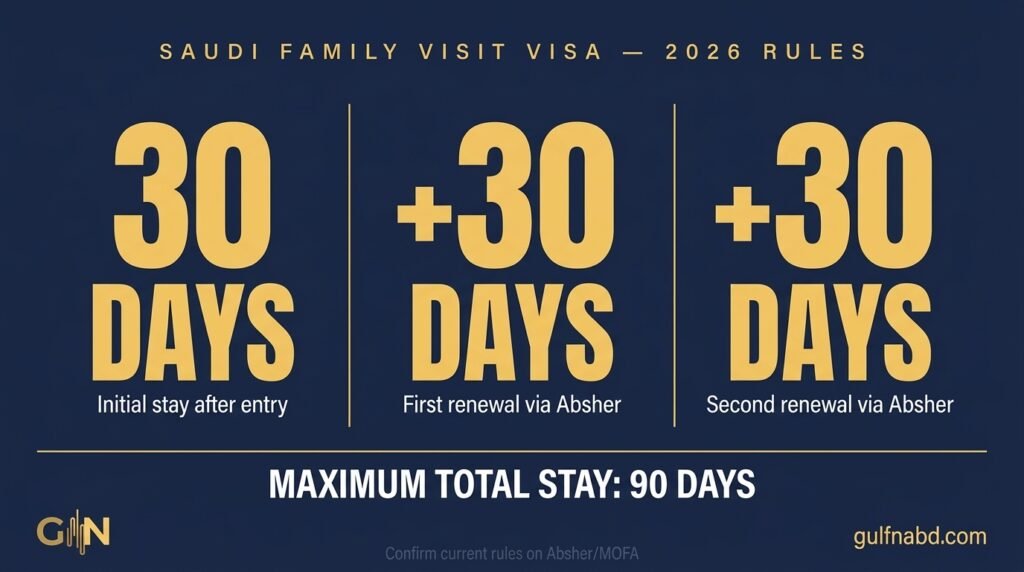
A single-entry family visit visa now works on a shorter initial window than a lot of older guides still describe. Under the current framework, the visitor needs to enter the Kingdom within one month of issuance, and the initial allowed stay is capped at 30 days rather than 90.
From there, the stay is extended in stages rather than granted upfront. Each renewal through Absher adds another 30 days, and a single-entry visa can be pushed to a maximum total stay of around 90 days by renewing twice (30, then 30, then 30 again). A multiple-entry visa, on the occasions it’s available, runs for 6 months, 1 year, or 2 years depending on the type you’re issued, with each individual stay still capped at 90 days per entry.
Start each renewal 10 to 14 days before the current period expires to avoid last-day system issues. Each 30-day renewal commonly costs around SAR 140 to 150, which includes the mandatory insurance extension rather than being a flat SAR 100 government fee on its own. Treat this as a figure to confirm on the portal at the time, since renewal costs have moved around as the rules have changed.
Once the maximum allowed stay is reached, the visitor has to leave the Kingdom. The family visit visa can’t be converted into an Iqama or a work visa. If long-term residence is the actual goal, a dependent Iqama through Absher Business (a family residence visa) is the correct path, not repeated visit-visa extensions.
Where People Get Stuck
Three patterns show up again and again.
Mismatched names or dates. The platform’s automated filters check name and passport data with zero tolerance for inconsistency. Double, then triple, check spelling against the actual passport, not a previous document.
Waiting too long to extend. Submitting an extension request in the final day or two before expiry leaves no buffer if the system flags anything. Start the extension 10 to 14 days before the visa lapses.
Assuming the visa allows work. It doesn’t, not even informal or unpaid work. Immigration enforcement on this has tightened, and sponsors are the ones held accountable, with penalties that can be severe.
A few other issues worth watching for: an Iqama with under 90 days of validity at submission, a profession that isn’t eligible for family sponsorship, skipping the Chamber of Commerce or employer attestation step in cases where it does apply, non-ICAO photos (glasses, shadows, wrong size or background), and unattested or untranslated relationship documents.
Bringing It Together
The family visit visa system in Saudi Arabia has gotten more centralized, and honestly more predictable, once you know the sequence. Confirm your eligibility first: Iqama type, profession, validity, and salary context. Get every document attested and translated correctly. Apply through Absher or Muqeem, with your Nafath identity verified and linked. Check whether Chamber of Commerce or employer attestation applies to your case. Pay the right fees, including mandatory insurance. Then track your request number until the embassy or center stamps the passport.
If you’ve been through this recently, what tripped you up: the Nafath verification, the attestation step, or the insurance cost? And if you’re planning your first application, bookmark this guide and come back to it at the document-collection stage. That’s where the real time gets lost.
Visa rules and fees can change, and multiple-entry options in particular have shifted often. Always confirm current requirements on the official MOFA/Absher platforms before submitting your application.
Updated: 2026, based on MOFA, Enjaz, Absher, and embassy guidance available up to mid-2026.
